
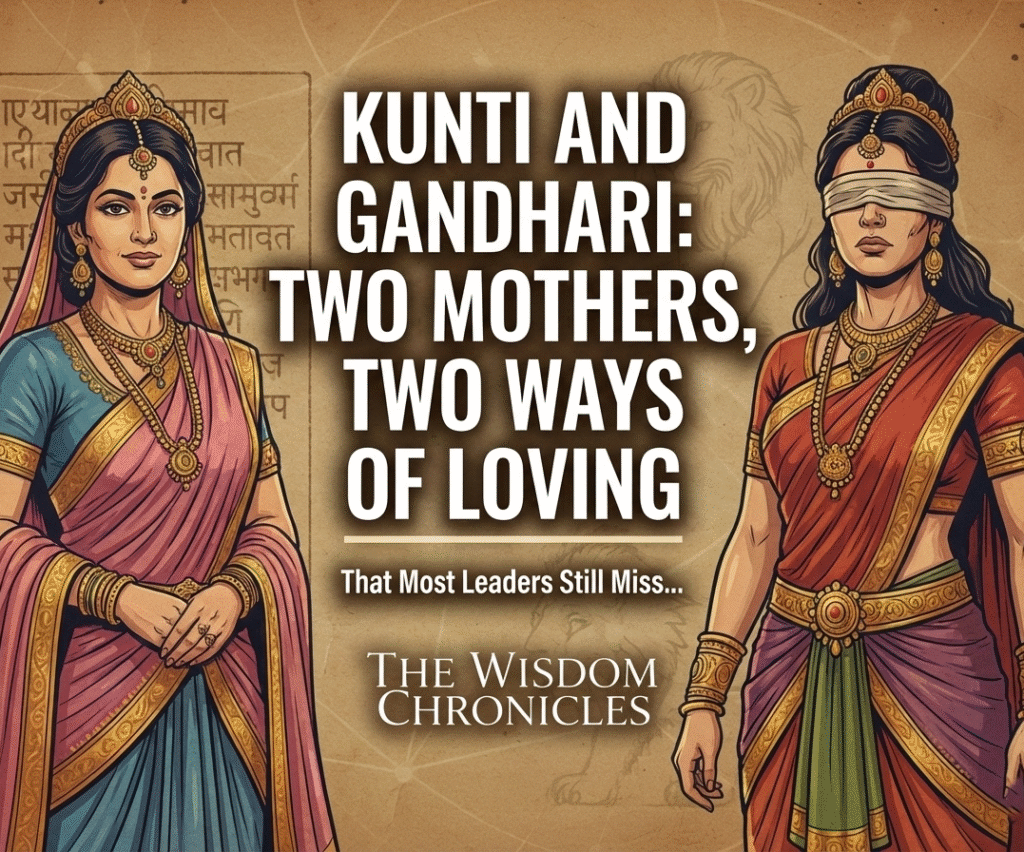
Kunti and Gandhari: Two Mothers, Two Ways of Loving
If you look closely at the Mahabharata, you’ll notice something quietly powerful.
Two women stand on opposite sides of the same story — Gandhari and Kunti.
Both were queens.
Both were mothers.
Both loved their children deeply.
And yet, the worlds their children grew into could not have been more different.
The difference wasn’t fate.
It wasn’t luck.
It was how each woman chose to see — or not see — reality.
Gandhari: Love That Looked Away
Gandhari had everything many would envy — comfort, status, protection, and a husband who respected her. When she learned that her husband was blind, she made a choice that history often calls noble: she blindfolded herself.
It was meant as loyalty.
It was meant as devotion.
But over time, that blindfold became more than a symbol of love. It became a way of not seeing.
Not seeing her son’s entitlement slowly harden into arrogance.
Not seeing how power was being misused in the court.
Not seeing how silence, when sustained long enough, can become permission.
Perhaps she didn’t blindfold herself because she was weak.
Perhaps she did it because seeing would have been too painful.
That’s the uncomfortable truth her story holds for us.
Sometimes, we don’t look away because we don’t care.
We look away because we care too much — and don’t know how to hold the discomfort that comes with truth.
But love that never questions can quietly cause damage.
Peace maintained through avoidance rarely lasts.
Kunti: Love That Stayed Awake
Kunti’s life was nothing like Gandhari’s.
She lost early.
She lived with uncertainty.
She raised her children while constantly adapting to loss, exile, and instability.
There was no blindfold to hide behind — and perhaps no luxury to look away even if she wanted to.
Kunti saw life as it was. Harsh. Unfair. Demanding.
And instead of shielding her children from it, she prepared them for it.
When they were sent into forests, she didn’t promise safety. She taught resilience.
When comfort disappeared, she taught strength.
When certainty vanished, she taught trust in themselves.
If Gandhari’s love tried to protect, Kunti’s love tried to prepare.
And that makes all the difference.
A Choice We Still Make Every Day
These two women don’t belong only to mythology.
You see Gandhari in parents who smooth every obstacle for their children.
In leaders who avoid tough conversations to “keep the peace”.
In people who sense something is wrong — but tell themselves it’s better not to stir things up.
You see Kunti in those who stay present even when it hurts.
In mentors who allow struggle but don’t abandon.
In parents who let their children fail — and stand close while they learn.
Both kinds of love come from care.
Only one builds strength.
Comfort or Clarity
Gandhari chose comfort — emotional, relational, moral comfort.
Kunti chose clarity — even when it cost her peace in the short term.
That choice keeps showing up in our lives.
The blindfold often feels kinder.
Clear sight feels demanding, sometimes lonely, often exhausting.
But clarity does something comfort cannot:
It prepares us — and those we love — for reality.
Why This Story Still Stays With Us
Kunti and Gandhari aren’t lessons to judge.
They are mirrors.
They show us two inner postures:
Turning away to preserve calm
Staying awake to protect what truly matters
The idea of inner wealth is not about being heroic or perfect.
It’s about noticing these patterns within ourselves — where we avoid, where we stay present, where love becomes enabling, and where it becomes strengthening.
A Gentle Invitation
If this story stayed with you, it’s probably because you’ve stood at this crossroads yourself — between comfort and clarity, between protecting and preparing.
Growing Your Inner Wealth explores these moments quietly and honestly — not through ideals to chase, but through awareness of how we relate to emotion, responsibility, courage, and love in everyday life.
The book doesn’t ask you to be harder or softer.
It simply helps you see more clearly — and choose with awareness.